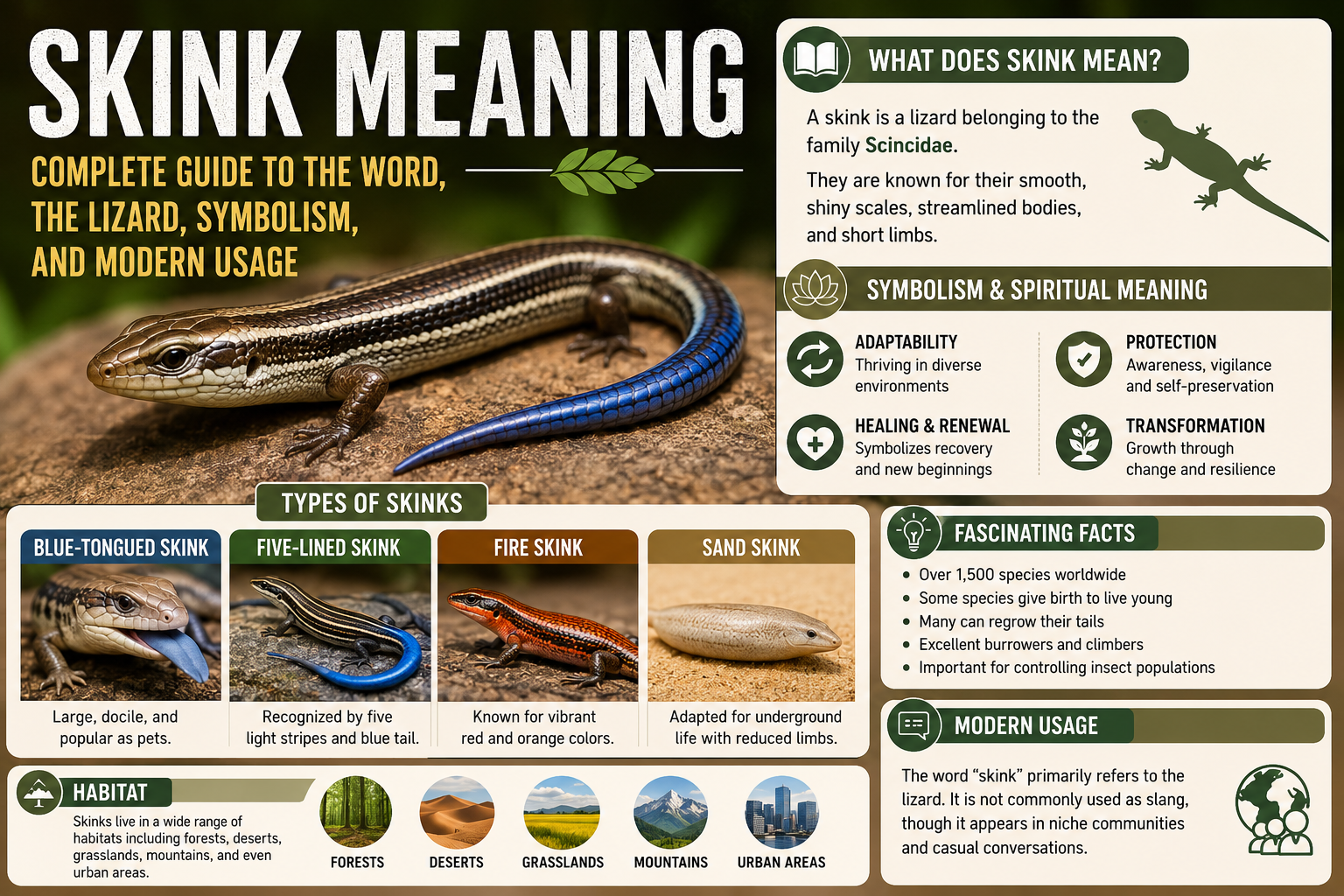

The term skink has a straightforward scientific meaning, but many people search for it because they encounter the word in different contexts, from wildlife documentaries and pet communities to mythology and internet discussions. Understanding the skink meaning requires looking beyond a simple dictionary definition.
At its core, a skink is a type of lizard belonging to one of the largest reptile families in the world. However, the word also carries cultural, symbolic, and regional significance that makes it more interesting than many people realize.
In this comprehensive guide, we’ll explore what a skink is, where the name comes from, the different species found globally, their symbolism in various cultures, their role as pets, and whether the term has any slang or modern meanings.
By the end, you’ll have a complete understanding of the word “skink” and why these remarkable reptiles continue to fascinate scientists and animal lovers alike.
What Does Skink Mean?
The meaning of skink refers primarily to a small to medium-sized lizard belonging to the family Scincidae.
Quick Definition
Skink (noun):
A smooth-scaled lizard characterized by elongated bodies, short limbs, and shiny, overlapping scales.
Skinks are among the most diverse reptiles on Earth, with more than 1,500 species identified across different continents.
Featured Snippet Answer
What is the meaning of skink?
A skink is a member of the lizard family Scincidae, known for smooth, glossy scales, streamlined bodies, and short legs. Some species are excellent burrowers, while others live in forests, deserts, and grasslands around the world.
The Origin and Etymology of the Word “Skink”
The word “skink” has ancient roots.
It originates from the Latin word scincus, which referred to a type of lizard known in classical times. The Greek language also used similar terms to describe certain reptiles found in North Africa and the Mediterranean region.
Over centuries, the English word evolved into skink, becoming the accepted name for the entire family of these distinctive lizards.
Interestingly, ancient civilizations often attributed medicinal or mystical properties to skinks, making them important in folklore and traditional practices.
What Is a Skink Lizard?
Skinks are reptiles belonging to the family Scincidae, one of the largest lizard families in existence.
They can be found on nearly every continent except Antarctica.
Common Characteristics of Skinks
Most skinks share several physical traits:
- Smooth, shiny scales
- Cylindrical or elongated bodies
- Short legs
- Strong burrowing abilities
- Long tails
- Excellent camouflage
- Quick movement
Some species have fully developed limbs, while others have tiny or nearly absent legs, making them resemble snakes.
These evolutionary adaptations help them survive in diverse habitats.
Different Types of Skinks Around the World
One reason the skink family is so fascinating is its incredible diversity.
1. Blue-Tongued Skink
Perhaps the most famous species, the blue-tongued skink is native to Australia and Indonesia.
Characteristics include:
- Large body size
- Bright blue tongue used for defense
- Calm temperament
- Popularity as exotic pets
2. Five-Lined Skink
Common in North America, this species is recognized by:
- Five light-colored stripes
- Bright blue tails in juveniles
- Forest habitat preferences
- Excellent climbing skills
3. Fire Skink
The fire skink is admired for its vibrant coloration.
Features include:
- Red and orange scales
- Black markings
- Burrowing behavior
- African origins
4. Sand Skinks
These unique reptiles have evolved specifically for life underground.
Their adaptations include:
- Reduced limbs
- Streamlined bodies
- Exceptional digging abilities
- Desert survival mechanisms
Physical Features That Make Skinks Unique
Skinks differ from many other lizards in several important ways.
Smooth Overlapping Scales
Unlike rough-scaled reptiles, skinks possess shiny, polished scales that overlap similarly to fish scales.
This provides:
- Better protection
- Reduced friction during movement
- Improved burrowing efficiency
Tail Autotomy
Many skinks can shed their tails to escape predators.
This process, known as autotomy, allows the detached tail to continue moving while the lizard escapes.
Although the tail often regenerates, the new version may look slightly different from the original.
Limb Reduction
Some skink species demonstrate remarkable evolutionary adaptations.
Certain varieties have:
- Tiny legs
- Partially developed limbs
- No visible limbs at all
Scientists study these animals to better understand evolutionary biology and reptilian development.
Where Do Skinks Live?
Skinks inhabit an impressive range of environments.
Common Habitats
They can be found in:
- Tropical forests
- Grasslands
- Deserts
- Mountain regions
- Coastal areas
- Urban gardens
Australia contains one of the greatest diversities of skink species, but they also thrive throughout Africa, Asia, Europe, and the Americas.
Their adaptability explains why the family has become one of the world’s most successful reptile groups.
What Do Skinks Eat?
The diet of a skink varies depending on the species.
Insect-Eating Skinks
Many consume:
- Crickets
- Beetles
- Spiders
- Worms
- Grasshoppers
Omnivorous Species
Some larger skinks eat:
- Fruits
- Vegetables
- Flowers
- Small vertebrates
- Eggs
Blue-tongued skinks, for example, maintain a highly varied diet that includes both animal and plant matter.
Skink Meaning in Symbolism and Spiritual Traditions
Animals often develop symbolic meanings across different cultures, and skinks are no exception.
Adaptability and Survival
Because skinks thrive in diverse environments, they commonly symbolize:
- Flexibility
- Resilience
- Adaptation
- Personal growth
Regeneration
Their ability to regenerate tails has inspired symbolic interpretations related to:
- Healing
- Renewal
- Recovery after hardship
- New beginnings
Protection and Awareness
The skink’s alert nature also connects it with:
- Vigilance
- Self-preservation
- Quick thinking
- Environmental awareness
While these meanings are not universal, they appear in various forms of modern spiritual discussions and animal symbolism.
Skinks in Mythology and Folklore
Ancient societies frequently associated reptiles with mystical powers.
Mediterranean Traditions
Early Greek and Roman writings sometimes referenced skinks in medicinal contexts.
People believed certain species possessed healing properties, though modern science does not support many of these claims.
African Folklore
In some African traditions, lizards—including skinks—symbolized:
- Transformation
- Environmental wisdom
- Survival instincts
Indigenous Australian Perspectives
Australia’s rich biodiversity includes numerous skink species, many of which hold cultural significance in Indigenous storytelling and ecological knowledge systems.
These stories often emphasize humanity’s connection with the natural world.
Are Skinks Good Pets?
One reason people search for the meaning of skink is their growing popularity as exotic pets.
The answer is yes—certain species make excellent companions when cared for responsibly.
Popular Pet Skinks
Common choices include:
- Blue-tongued skinks
- Fire skinks
- Schneider’s skinks
Why People Like Them
Pet owners appreciate skinks because they are:
- Generally docile
- Intelligent
- Relatively easy to handle
- Long-lived
- Fascinating to observe
Important Responsibilities
Potential owners should always consider:
- Proper habitat requirements
- Dietary needs
- Veterinary care
- Legal regulations
- Ethical sourcing
Research is essential before adopting any exotic animal.
Is “Skink” Used as Slang?
Most commonly, skink refers exclusively to the reptile family.
Unlike many animal names, it has not developed widespread modern slang meanings in mainstream English.
However, regional dialects and internet communities occasionally use the term in playful or niche ways, especially among reptile enthusiasts.
These uses are informal and far less common than the biological definition.
Therefore, when someone says “skink,” they almost always mean the lizard.
Differences Between Skinks and Other Lizards
People often confuse skinks with geckos, iguanas, or even snakes.
Here’s how they differ.
| Feature | Skinks | Geckos | Iguanas |
| Scales | Smooth and shiny | Granular | Rougher texture |
| Body Shape | Elongated | Compact | Larger and robust |
| Legs | Often short | Well-developed | Strong and long |
| Tail Loss | Common | Common | Less frequent |
| Habitat | Diverse | Mostly warm climates | Tropical environments |
Understanding these differences helps identify skinks more accurately in the wild.
Fascinating Facts About Skinks
Skinks are full of surprises.
Here are some interesting facts:
They Are One of the Largest Lizard Families
Scientists recognize over 1,500 skink species worldwide.
Some Species Give Birth to Live Young
Unlike many reptiles that lay eggs, certain skinks are viviparous and produce live offspring.
Blue Tails Help Protect Juveniles
Young skinks often have bright blue tails that attract predators away from vital body parts.
They Can Regrow Their Tails
Tail regeneration remains one of their most remarkable survival mechanisms.
Some Resemble Snakes
Several skink species have evolved reduced limbs, creating snake-like appearances while maintaining lizard characteristics.
Ecological Importance of Skinks
Skinks play essential roles in ecosystems.
Natural Pest Control
By consuming insects, they help regulate populations of:
- Beetles
- Mosquitoes
- Spiders
- Agricultural pests
Food Sources for Other Animals
Predators that rely on skinks include:
- Birds
- Snakes
- Mammals
- Larger reptiles
Environmental Indicators
Healthy skink populations often indicate stable ecosystems and balanced habitats.
Scientists sometimes use reptile diversity as a measure of environmental quality.
Why People Search for “Skink Meaning”
Search data suggests that users typically have several intentions behind this keyword.
Common reasons include:
- Identifying an unusual animal
- Understanding a pet species
- Learning spiritual symbolism
- Clarifying dictionary definitions
- Exploring biological information
- Investigating folklore references
This broad curiosity explains why comprehensive explanations are especially valuable.
Conclusion
The skink meaning extends far beyond a simple dictionary definition. Scientifically, it refers to an incredibly diverse family of lizards characterized by smooth scales, adaptable behaviors, and remarkable evolutionary traits. Yet their significance also reaches into folklore, symbolism, ecological importance, and modern pet culture.
Whether you’re identifying a reptile in your backyard, researching animal symbolism, or considering a skink as a pet, understanding these fascinating creatures offers valuable insight into one of nature’s most successful reptile groups.
From their regenerative abilities to their worldwide diversity, skinks remain powerful examples of adaptation and resilience—qualities that continue to capture human curiosity across generations.
Frequently Asked Questions (FAQ)
What does skink mean?
A skink is a lizard belonging to the family Scincidae, known for smooth scales, short limbs, and elongated bodies. The family includes more than 1,500 species found around the world.
Is a skink a lizard or a snake?
A skink is a lizard. Although some species have reduced limbs and resemble snakes, they remain true lizards with distinct anatomical features.
Are skinks dangerous to humans?
Most skinks are harmless to humans. They are generally shy, non-aggressive reptiles that prefer avoiding confrontation.
What does a skink symbolize spiritually?
Spiritually, skinks often represent adaptability, renewal, healing, resilience, and personal transformation because of their survival skills and tail regeneration abilities.
Can skinks be kept as pets?
Yes. Species such as blue-tongued skinks and fire skinks are popular pets when provided with proper housing, nutrition, and veterinary care.
Why do skinks lose their tails?
Skinks shed their tails as a defense mechanism called autotomy. The detached tail distracts predators, allowing the lizard to escape.
Where are skinks found?
Skinks live across Africa, Australia, Asia, Europe, and the Americas, inhabiting forests, deserts, grasslands, and urban environments.