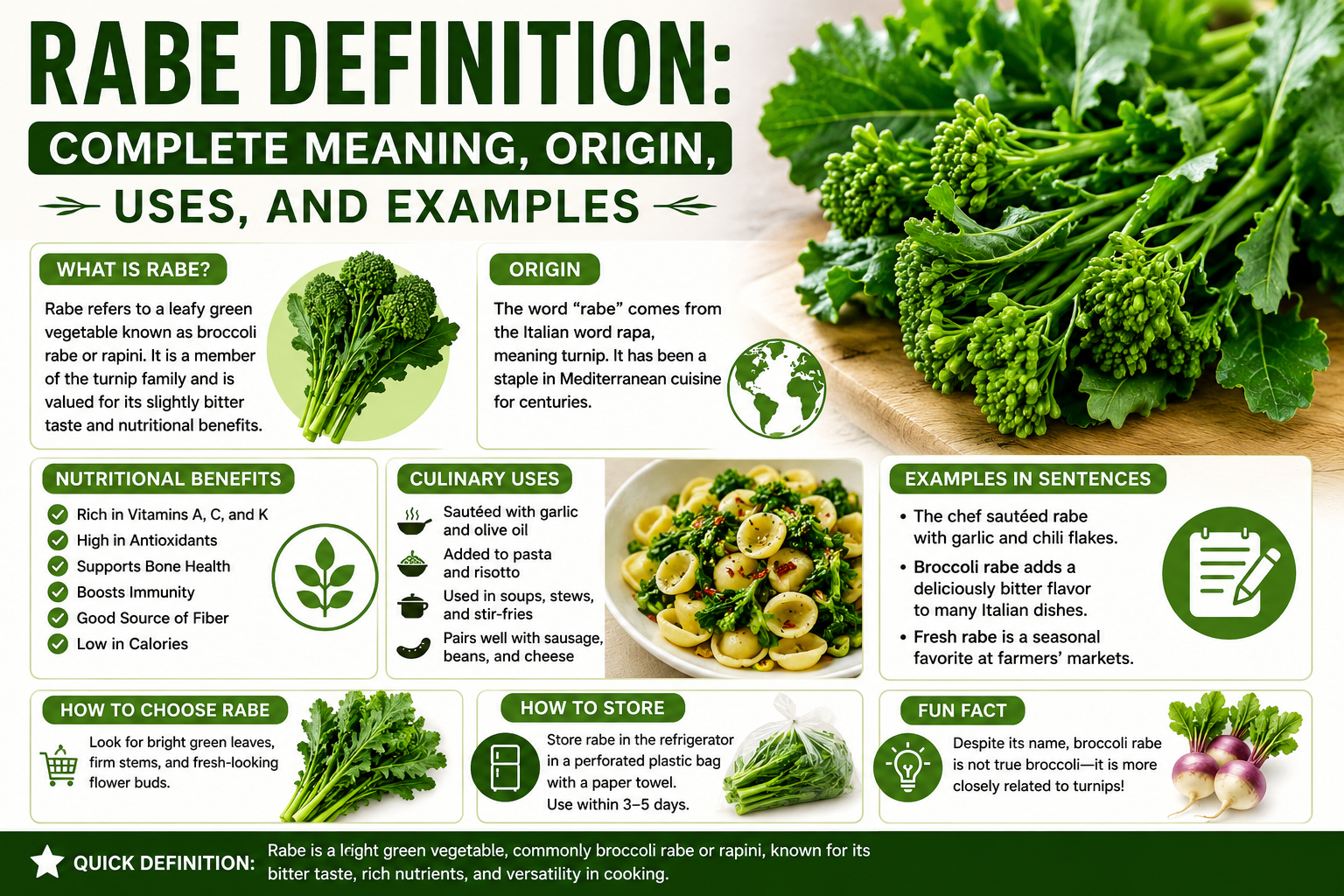

When people search for the rabe definition, they are often trying to understand whether the word refers to a vegetable, a surname, or something else entirely. In everyday English, the term rabe most commonly refers to a leafy green vegetable known as broccoli rabe or rapini. However, the word can have additional meanings depending on the context.
This comprehensive guide explains the definition of rabe, its origins, pronunciation, culinary significance, nutritional value, and common uses. By the end, you’ll have a complete understanding of what rabe means and how the term is used in different situations.
What Is the Definition of Rabe?
Rabe is a noun that most commonly refers to a green cruciferous vegetable, particularly in the phrase broccoli rabe. Despite its name, broccoli rabe is not actually broccoli. It belongs to the turnip family and is known for its leafy greens, small florets, and slightly bitter flavor.
Simple Definition
Rabe (noun):
A leafy green vegetable related to turnips and mustard greens, often used in Italian, Mediterranean, and Asian cooking.
Dictionary-Style Definition
Rabe: A vegetable consisting of edible leaves, stems, and flower buds from a plant in the Brassica family, especially broccoli rabe (rapini).
How Do You Pronounce Rabe?
The word rabe is typically pronounced:
RAYB
(/reɪb/)
In culinary contexts, many people encounter the term through broccoli rabe, which is commonly pronounced:
BROK-uh-lee RAYB
Because the spelling is uncommon, some people mistakenly pronounce it as “rah-be” or “rab-ee,” but “rayb” is generally accepted in English-speaking regions.
What Is Broccoli Rabe?
Broccoli rabe, also known as rapini, is the most common association with the word “rabe.”
Key Characteristics
- Dark green leaves
- Thin stems
- Small broccoli-like buds
- Slightly bitter taste
- Rich nutritional profile
Although it resembles young broccoli, broccoli rabe is actually more closely related to turnips than to broccoli.
Scientific Classification
- Family: Brassicaceae
- Genus: Brassica
- Species: Brassica rapa
This places it alongside vegetables such as:
- Turnips
- Mustard greens
- Bok choy
- Napa cabbage
Why Is It Called Rabe?
The term rabe is believed to derive from the Italian word rapa, meaning turnip.
As Italian immigrants brought traditional vegetables and recipes to North America, the name evolved in English usage. Over time, “broccoli rabe” became the commonly recognized term in grocery stores and recipes.
The vegetable’s close relationship to turnips explains why its botanical classification differs from true broccoli.
Is Rabe the Same as Rapini?
Yes, in most culinary contexts, rabe and rapini refer to the same vegetable.
Comparison
| Term | Meaning |
| Rabe | Shortened form commonly used in the U.S. |
| Broccoli Rabe | Full name used in supermarkets and recipes |
| Rapini | Italian name for the vegetable |
While regional preferences vary, all three terms generally describe the same leafy green plant.
What Does Rabe Taste Like?
One of the most distinctive features of rabe is its flavor.
Flavor Profile
Rabe is:
- Slightly bitter
- Earthy
- Peppery
- Nutty when cooked
- More robust than spinach
The bitterness comes from naturally occurring compounds found in cruciferous vegetables.
How Cooking Changes the Flavor
Cooking can reduce bitterness and create a more balanced taste.
Popular cooking methods include:
- Sautéing
- Steaming
- Roasting
- Blanching
- Stir-frying
Many chefs pair rabe with ingredients such as:
- Garlic
- Olive oil
- Chili flakes
- Lemon
- Sausage
- Parmesan cheese
These flavors complement its natural bitterness.
Nutritional Benefits of Rabe
Rabe is considered a nutrient-dense vegetable and is frequently recommended as part of a healthy diet.
Key Nutrients
Broccoli rabe contains:
- Vitamin A
- Vitamin C
- Vitamin K
- Folate
- Calcium
- Potassium
- Iron
- Fiber
Health Benefits
Regular consumption may support:
Bone Health
The high vitamin K content contributes to bone strength and proper calcium utilization.
Immune Function
Vitamin C helps support immune system performance and tissue repair.
Digestive Health
Fiber promotes healthy digestion and may help maintain gut health.
Heart Health
Leafy greens like rabe contain antioxidants and minerals that support cardiovascular wellness.
Cellular Protection
Cruciferous vegetables contain compounds associated with antioxidant activity that help protect cells from oxidative stress.
Common Culinary Uses of Rabe
Rabe is widely used in Mediterranean and Italian cuisine.
Popular Dishes
Sautéed Broccoli Rabe
One of the simplest preparations involves sautéing the vegetable with:
- Olive oil
- Garlic
- Red pepper flakes
Pasta Dishes
Rabe pairs exceptionally well with:
- Orecchiette pasta
- Penne
- Linguine
Its bitterness balances rich sauces and cheeses.
Sandwiches
Italian-style sandwiches often combine:
- Broccoli rabe
- Sausage
- Provolone cheese
This creates a savory and flavorful meal.
Soups and Stews
The vegetable can be added to:
- Vegetable soups
- Bean stews
- Broths
Side Dishes
Many restaurants serve rabe as a healthy side alongside:
- Grilled meats
- Fish
- Chicken
How to Store Rabe
Proper storage helps maintain quality.
Best Storage Method
- Wrap loosely in a damp paper towel.
- Place in a perforated plastic bag.
- Store in the refrigerator.
Shelf Life
Fresh rabe generally lasts:
3–5 days in the refrigerator.
For best flavor, use it as soon as possible after purchase.
Rabe vs. Broccoli: What’s the Difference?
Many people assume broccoli rabe is simply a type of broccoli.
However, there are important differences.
| Feature | Broccoli Rabe | Broccoli |
| Plant Family | Turnip relative | True broccoli |
| Flavor | Bitter | Mild |
| Edible Parts | Leaves, stems, buds | Large flower heads |
| Texture | Leafy | Dense |
| Culinary Use | Italian cuisine | Universal |
Although they share a similar appearance, they are botanically distinct vegetables.
Rabe vs. Spinach
Another common comparison is between rabe and spinach.
Rabe
- Bitter flavor
- Firmer texture
- More robust taste
- Best cooked
Spinach
- Mild flavor
- Tender leaves
- Can be eaten raw
- Sweeter profile
Rabe provides a stronger flavor that stands up well in hearty dishes.
Other Meanings of the Word Rabe
While culinary usage is the most common meaning, “Rabe” can appear in other contexts.
As a Surname
Rabe is also a family name found in several countries, especially:
- Germany
- United States
- Scandinavian regions
The surname has historical roots and may derive from words associated with ravens or regional occupations.
In Personal Names
You may encounter individuals with the last name Rabe in fields such as:
- Literature
- Politics
- Business
- Science
In these cases, the word functions as a proper noun rather than referring to the vegetable.
Example Sentences Using Rabe
Understanding a word becomes easier when seen in context.
Culinary Examples
- “The chef sautéed rabe with garlic and olive oil.”
- “Broccoli rabe adds a pleasant bitterness to pasta dishes.”
- “Fresh rabe was available at the farmers market.”
Name Examples
- “Rabe published several influential works during his career.”
- “The Rabe family has lived in the region for generations.”
Context usually makes the intended meaning clear.
Why Is Rabe Popular in Italian Cuisine?
Italian cooking often emphasizes balance between flavors.
The slight bitterness of rabe complements richer ingredients such as:
- Sausage
- Olive oil
- Cheese
- Pasta
Traditional southern Italian recipes frequently feature broccoli rabe because it grows well in Mediterranean climates and provides a nutritious, flavorful ingredient.
Its ability to add complexity to simple dishes has made it a staple in Italian-American cooking as well.
Featured Snippet Answer: What Does Rabe Mean?
Rabe is a leafy green vegetable, most commonly referring to broccoli rabe (rapini), a member of the turnip family known for its edible leaves, stems, and buds. It has a slightly bitter flavor and is widely used in Italian and Mediterranean cuisine.
Frequently Asked Questions
Is rabe the same as broccoli?
No. Although broccoli rabe resembles broccoli, it is actually more closely related to turnips and mustard greens.
What is another name for rabe?
The most common alternative name is rapini. Many grocery stores also label it as broccoli rabe.
Is rabe healthy?
Yes. Rabe is rich in vitamins A, C, and K, along with fiber, calcium, iron, and antioxidants.
Can you eat rabe raw?
You can, but most people prefer it cooked because cooking reduces its natural bitterness and improves texture.
Why is broccoli rabe bitter?
Its bitterness comes from naturally occurring compounds found in cruciferous vegetables, similar to mustard greens and kale.
How do you pronounce rabe?
Rabe is typically pronounced “rayb” (/reɪb/).