
Managing multiple debts can quickly become overwhelming. Between different interest rates, payment due dates, and lenders, many borrowers find themselves struggling to stay organized while paying more in interest than necessary. That’s where TraceLoans.com debt consolidation enters the conversation. Many people searching for debt relief want to know whether the platform can help simplify repayments, reduce financial stress, and potentially save money over time.
This comprehensive guide explains everything you need to know about TraceLoans.com debt consolidation, including how debt consolidation works, who may benefit from it, potential advantages and disadvantages, qualification requirements, alternatives, and expert strategies for improving your financial future. Whether you’re dealing with credit card debt, personal loans, or multiple monthly payments, this guide will help you make an informed decision.
What Is TraceLoans.com Debt Consolidation?
TraceLoans.com debt consolidation refers to using the TraceLoans platform to explore debt consolidation loan opportunities from lending partners or financial institutions.
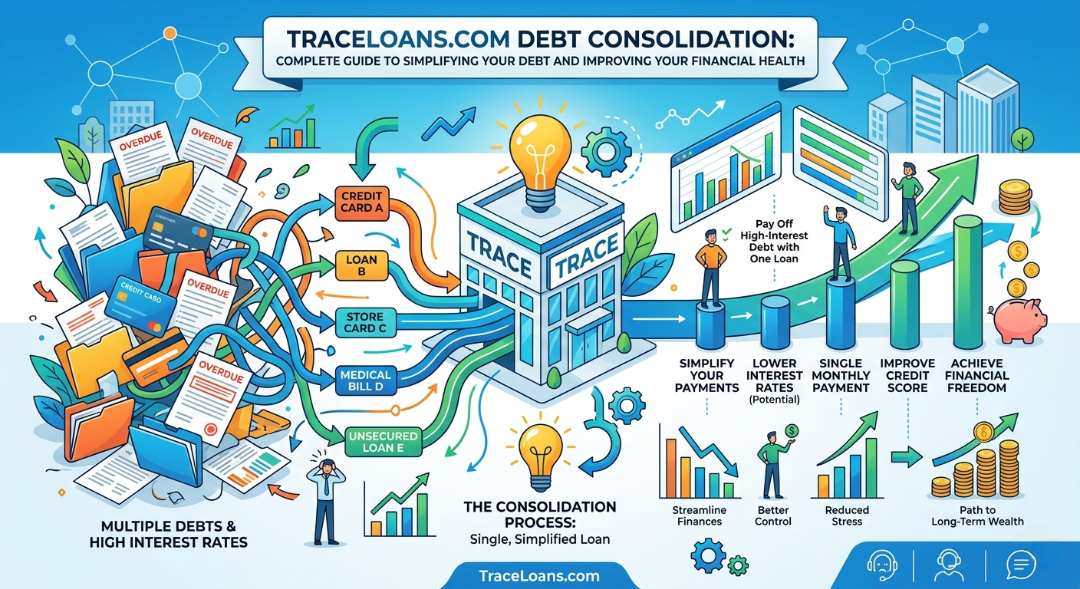
Rather than juggling several monthly payments, borrowers may be able to combine eligible debts into a single loan with one monthly payment and one interest rate.
The primary goal isn’t simply borrowing more money it is restructuring existing debt into a more manageable repayment plan.
Common debts that may qualify include:
- Credit card balances
- Personal loans
- Medical bills
- Payday loans
- Retail financing balances
- High-interest installment loans
Instead of making five or six payments every month, borrowers make one payment toward their consolidation loan.
How Does Debt Consolidation Work?
Debt consolidation follows a relatively straightforward process.
Step 1: Evaluate Existing Debt
Borrowers calculate:
- Total debt balance
- Current interest rates
- Monthly payments
- Remaining repayment terms
Understanding these numbers helps determine whether consolidation makes financial sense.
Step 2: Apply Through the Platform
Users typically complete an online application providing:
- Income information
- Employment details
- Credit history
- Existing debt obligations
Step 3: Receive Loan Offers
If approved, borrowers may receive loan options from participating lenders.
Loan offers generally include:
- Interest rate
- Loan amount
- Repayment term
- Monthly payment
- Fees (if applicable)
Step 4: Pay Off Existing Debts
After accepting an offer, funds are often used to pay existing creditors.
Instead of multiple accounts, borrowers begin repaying one consolidation loan.
Why Do People Choose TraceLoans.com Debt Consolidation?
Many borrowers seek consolidation because financial management becomes easier.
Common reasons include:
One Monthly Payment
Instead of remembering numerous due dates, borrowers manage a single payment every month.
This reduces the chance of missed payments.
Potentially Lower Interest Rates
Credit cards often charge:
- 20%
- 25%
- Even 30% APR or higher
If borrowers qualify for a lower-rate consolidation loan, they may significantly reduce total interest costs over time.
Predictable Repayment Schedule
Most consolidation loans have fixed monthly payments.
This allows borrowers to:
- Budget more effectively
- Plan future expenses
- Track repayment progress
Reduced Financial Stress
Keeping track of multiple creditors creates unnecessary pressure.
Many borrowers appreciate the simplicity of one structured repayment plan.
Who May Benefit from Debt Consolidation?
Debt consolidation isn’t ideal for everyone.
However, it may benefit individuals who:
- Have multiple high-interest debts
- Can qualify for a lower interest rate
- Have stable income
- Want organized repayment
- Struggle with managing multiple payment dates
It may be particularly useful for borrowers carrying substantial credit card balances.
Types of Debt That Can Often Be Consolidated
Not every debt qualifies.
Common eligible debts include:
Credit Card Debt
One of the most common reasons people seek consolidation.
High-interest revolving balances can become expensive if only minimum payments are made.
Personal Loans
Multiple unsecured loans may sometimes be combined into one larger loan.
Medical Bills
Medical expenses can become difficult to manage after unexpected emergencies.
Consolidation may simplify repayment.
Store Credit Accounts
Retail financing often carries high interest after promotional periods expire.
Payday Loan Debt
Some borrowers use consolidation to replace costly short-term loans with longer repayment schedules.
Benefits of TraceLoans.com Debt Consolidation
Let’s examine the biggest potential advantages.
1. Simplified Financial Management
Managing one payment instead of several reduces administrative hassle.
This helps improve budgeting and organization.
2. Potential Interest Savings
Lower APR means more of each payment goes toward reducing principal instead of paying interest.
Over several years, the savings can become substantial.
3. Improved Cash Flow
Lower monthly payments may create additional room in the household budget.
That extra flexibility can help build emergency savings.
4. Faster Debt Payoff
Some borrowers choose shorter repayment terms to eliminate debt more quickly.
Although monthly payments may be higher, total interest paid often decreases.
5. Better Credit Management
Consistent on-time payments may contribute positively to long-term credit health.
However, results vary depending on individual financial circumstances.
Potential Drawbacks to Consider
Debt consolidation isn’t automatically the best solution.
Borrowers should understand possible disadvantages.
Longer Repayment Terms
Lower monthly payments sometimes mean extending the loan duration.
This could increase total interest paid despite lower monthly costs.
Qualification Requirements
Approval often depends on:
- Credit score
- Income
- Existing debt
- Debt-to-income ratio
Not every applicant receives favorable rates.
Fees
Some lenders charge:
- Origination fees
- Late payment fees
- Administrative fees
Always review loan documents carefully.
Continued Spending
One common mistake is paying off credit cards through consolidation and then accumulating new balances.
Without disciplined spending habits, debt problems may worsen.
How Credit Scores Affect Debt Consolidation
Credit scores influence nearly every part of the lending process.
Higher credit scores often qualify for:
- Lower interest rates
- Larger loan amounts
- Better repayment terms
Lower scores may still receive offers but with:
- Higher APRs
- Smaller loan amounts
- Stricter approval requirements
Improving credit before applying may increase available options.
Factors Lenders Commonly Review
While each lender has unique requirements, most evaluate several financial factors.
Income Stability
Steady employment demonstrates repayment ability.
Debt-to-Income Ratio
This compares monthly debt obligations against monthly income.
Lower ratios generally improve approval chances.
Credit History
Responsible borrowing history helps build lender confidence.
Payment History
Consistently paying bills on time remains one of the strongest indicators of future repayment.
How to Decide Whether Debt Consolidation Is Right for You
Before applying, ask yourself these questions.
Are my current interest rates very high?
If most debts carry interest above 20%, consolidation may reduce borrowing costs.
Can I qualify for a lower rate?
Without a lower interest rate, consolidation may not generate meaningful savings.
Will I avoid creating new debt?
Financial discipline remains essential.
Debt consolidation works best alongside responsible spending.
Can I comfortably afford the monthly payment?
Choose a repayment plan that fits your long-term budget.
Debt Consolidation vs. Debt Settlement
Many people confuse these two financial strategies.
| Debt Consolidation | Debt Settlement |
| Combines debts into one loan | Negotiates reduced balances |
| Requires repayment of full balance | Creditors may accept partial payment |
| Less damaging to credit in many cases | Can significantly impact credit |
| Easier monthly management | Often involves negotiation |
Understanding this distinction helps borrowers select the right solution.
Debt Consolidation vs. Balance Transfer Cards
Balance transfer cards may also reduce interest.
However, they differ significantly.
Balance Transfer Cards
Pros:
- Promotional 0% APR offers
- Potential short-term savings
Cons:
- Introductory period expires
- Transfer fees
- Lower credit limits
Consolidation Loans
Pros:
- Fixed repayment schedule
- Fixed monthly payments
- Longer repayment periods
Cons:
- Interest depends on creditworthiness
- Loan qualification required
Practical Tips Before Applying
Improve your approval chances with these strategies.
Check Your Credit Report
Correct any reporting errors before submitting applications.
Reduce Existing Balances
Paying down smaller debts may improve debt-to-income ratio.
Compare Multiple Offers
Never accept the first loan offer without comparing:
- APR
- Fees
- Loan term
- Monthly payment
- Total repayment cost
Calculate Total Loan Cost
Focus on total repayment—not just monthly payments.
Lower monthly payments can sometimes hide higher lifetime costs.
Common Mistakes to Avoid
Many borrowers unintentionally reduce the benefits of debt consolidation.
Avoid these mistakes:
- Closing credit accounts immediately
- Missing consolidation payments
- Borrowing additional money
- Ignoring loan fees
- Choosing the longest repayment term without comparing costs
- Failing to create a monthly budget
Good financial habits are just as important as the loan itself.
Ways to Stay Debt-Free After Consolidation
Debt consolidation works best when combined with healthier financial habits.
Consider these strategies:
- Build an emergency fund
- Track monthly spending
- Follow a realistic budget
- Limit unnecessary credit use
- Pay more than the minimum whenever possible
- Review finances every month
Consistency matters more than perfection.
Conclusion
TraceLoans.com debt consolidation can be a useful option for borrowers seeking a more organized way to manage multiple debts. By combining eligible balances into a single loan, many individuals gain the convenience of one monthly payment, potentially lower interest rates, and a clearer path toward becoming debt-free.
However, consolidation is not a one-size-fits-all solution. The best outcome depends on securing favorable loan terms, understanding all associated costs, and maintaining responsible financial habits after consolidation. Before accepting any loan offer, compare interest rates, repayment periods, fees, and the total borrowing cost rather than focusing solely on lower monthly payments.
When paired with disciplined budgeting, consistent on-time payments, and a commitment to avoiding unnecessary new debt, debt consolidation can become more than a short-term fix it can serve as the foundation for stronger long-term financial stability and greater peace of mind.
Frequently Asked Questions (FAQ)
Is TraceLoans.com debt consolidation a direct lender?
TraceLoans.com is generally presented as a platform that helps users explore loan opportunities rather than functioning as a direct lender. Available offers depend on participating lending partners and individual eligibility.
Can debt consolidation lower my monthly payment?
Yes, it can. A lower interest rate or a longer repayment period may reduce monthly payments. However, extending the loan term could increase total interest paid over time.
Does debt consolidation hurt your credit score?
Applying for a loan may result in a temporary credit inquiry. Over time, making consistent, on-time payments and reducing revolving debt can support healthier credit, although results vary for every borrower.
Can I consolidate credit card debt?
Yes. Credit card balances are among the most common types of debt included in consolidation loans.
What credit score is needed?
Requirements differ by lender. Higher credit scores generally qualify for better rates, but some lenders consider applicants with fair or developing credit profiles.
Is debt consolidation better than debt settlement?
They serve different purposes. Debt consolidation focuses on simplifying repayment, while debt settlement attempts to reduce the total amount owed, often with greater potential impact on credit.
How long does repayment usually last?
Loan terms vary depending on the lender, loan amount, and borrower qualifications. Repayment periods commonly range from two to seven years.
Can I pay off a consolidation loan early?
Many lenders allow early repayment, although borrowers should review loan agreements for any prepayment penalties before accepting an offer.