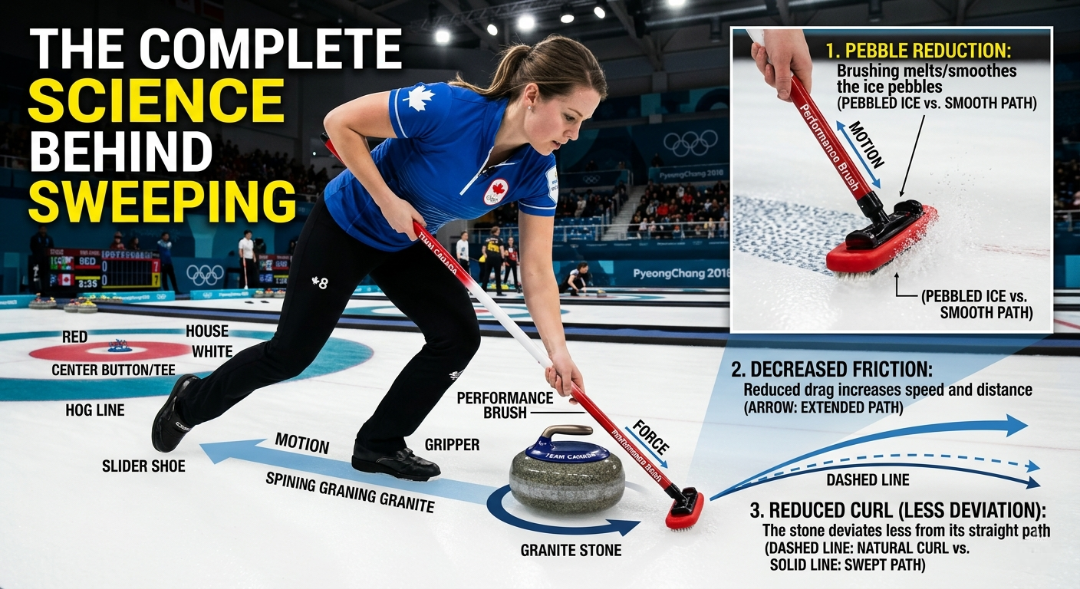

Curling is often called “chess on ice,” but anyone who has watched the Winter Olympics knows it’s much more than carefully placing stones. One of the most fascinating aspects of the sport is sweeping. Two players vigorously brush the ice in front of a moving stone, seemingly changing its direction and distance.
This naturally leads many viewers to ask: how do brushes affect the stone’s path in Olympic curling?
The short answer is that sweeping changes the ice surface just enough to reduce friction. This helps the stone travel farther, maintain more speed, and slightly alters how much it curls. However, contrary to popular belief, sweepers cannot magically steer a stone wherever they want. Instead, they influence the stone within predictable physical limits.
In this comprehensive guide, you’ll discover exactly how curling brushes work, the science behind sweeping, why Olympic teams spend countless hours mastering the technique, and how rule changes have shaped modern curling.
Quick Answer
If you’re looking for the simple explanation, here’s the answer:
Brushes affect the stone’s path in Olympic curling by reducing friction between the stone and the ice. Sweeping creates a thin layer of warmth on the ice surface, allowing the stone to travel farther, lose less speed, and curl less than it otherwise would. Skilled sweepers can influence the final position of a stone by several feet, but they cannot completely redirect it.
Understanding the Basics of Curling
Before diving into the science of sweeping, it’s important to understand how a curling stone naturally behaves.
Each curling stone:
- Weighs approximately 44 pounds (20 kg)
- Is made from dense granite
- Slides over specially prepared pebbled ice
- Rotates slowly during delivery
- Naturally curves (or “curls”) as it slows down
Unlike a hockey puck, a curling stone doesn’t travel in a perfectly straight line. The rotation and interaction with the textured ice create the signature curved path that gives curling its name.
This natural curl is exactly what sweepers try to influence.
What Is a Curling Brush?
A curling brush is a specialized tool designed to sweep the ice ahead of a moving stone.
Modern Olympic curling brushes include:
- Lightweight composite handles
- High-performance fabric brush heads
- Ergonomic grips
- Replaceable approved brush pads
Today’s brushes are much more advanced than the corn brooms used decades ago. Modern synthetic materials allow athletes to apply greater pressure while remaining within regulations.
How Does Sweeping Actually Work?
Many people assume sweeping simply melts the ice.
While that’s partially true, the real process is more complex.
Sweeping affects three important factors:
1. It Reduces Friction
As sweepers rapidly move the brush back and forth, friction between the brush and ice generates a tiny amount of heat.
This heat:
- Smooths the tops of the ice pebbles
- Reduces resistance
- Allows the stone to glide more efficiently
Even a very small temperature change can noticeably affect the stone over nearly 100 feet of travel.
2. It Helps the Stone Travel Farther
Without sweeping:
- The stone slows more quickly.
- Friction increases.
- The stone stops sooner.
With sweeping:
- Speed is maintained longer.
- Momentum decreases more slowly.
- The stone continues farther down the sheet.
Elite sweepers can extend a stone’s travel by several feet.
3. It Reduces Curl
One of the biggest effects of sweeping is reducing how much the stone curves.
Because the stone retains more speed:
- It spends less time in the slow-speed phase.
- Less sideways movement develops.
- The final curl is smaller.
This allows players to “hold the line” on difficult shots.
Why Does a Curling Stone Curl in the First Place?
Scientists have studied curling for decades.
Although research continues, several factors contribute to curling:
- The stone rotates.
- The running band contacts the pebble.
- Friction varies across the contact area.
- The textured ice influences movement.
- The stone’s speed gradually decreases.
Interestingly, most of the curl happens near the end of the shot rather than immediately after release.
That’s why sweeping late in the shot can be incredibly important.
Can Sweepers Change Direction?
This is one of the biggest misconceptions among new viewers.
Sweepers cannot suddenly make a stone turn left or right.
Instead, they influence the amount of curl that naturally develops.
Think of it this way:
Without sweeping:
- Stone curls 4 feet.
With aggressive sweeping:
- Stone curls only 2.5 feet.
The path changes because the curl is reduced not because the brush physically pushes the stone sideways.
The Science Behind Olympic Sweeping
Elite curling teams rely on physics rather than guesswork.
Several scientific principles explain why sweeping works.
Friction
Lower friction means:
- More speed
- Greater distance
- Reduced sideways motion
Heat Generation
Sweeping raises the ice temperature by only fractions of a degree.
Even this tiny increase:
- Softens the pebble surface
- Changes the interaction between granite and ice
- Improves glide
Surface Smoothing
The brush doesn’t simply melt ice.
It also:
- Polishes pebble tops
- Removes tiny frost particles
- Creates a more consistent sliding surface
Speed Retention
A faster stone:
- Travels straighter
- Curls less
- Is easier to control
This is why sweepers often begin brushing immediately after release.
Why Olympic Sweepers Are So Strong
Watching Olympic curlers sweep can be exhausting.
There’s a reason for that.
Elite sweepers may apply:
- Over 90 pounds of downward force
- Extremely high brush speeds
- Continuous sweeping for several seconds
The harder and faster they sweep, the greater the effect.
Modern curling demands impressive cardiovascular fitness, upper-body strength, and endurance.
Different Types of Sweeping
Not every shot requires maximum effort.
Power Sweeping
Used when:
- Stone is light
- Extra distance is needed
- Maximum speed retention is required
Directional Sweeping
Modern teams sometimes apply pressure on one side of the running path.
While regulations now limit how much directional influence is possible, experienced sweepers still use subtle techniques to optimize the stone’s path.
Late Sweeping
Some shots require waiting until the final seconds.
Late sweeping helps:
- Prevent excessive curl
- Reach the target
- Fine-tune final positioning
How Teams Decide When to Sweep
Communication is everything.
The skip watches:
- Line
- Weight
- Curl
- Speed
- Ice conditions
Meanwhile, sweepers constantly evaluate:
- Stone rotation
- Remaining distance
- Ice speed
- Opponent stones
Calls like:
- “Hard!”
- “Clean!”
- “Off!”
are made in fractions of a second.
Ice Conditions Matter More Than Many People Realize
No two sheets of curling ice behave exactly the same.
Factors include:
- Arena temperature
- Humidity
- Pebble quality
- Ice maintenance
- Number of previous games
Olympic teams spend practice sessions learning exactly how each sheet responds.
How Much Difference Can Sweeping Really Make?
Research and elite competition suggest sweeping can:
- Add several feet of travel
- Reduce curl by several inches to more than a foot
- Help a stone stay on its intended line
- Improve shot accuracy
At Olympic levels, even a one-inch improvement can determine whether a team scores multiple points or loses an end.
Brush Technology and Rule Changes
Modern brush technology became controversial in the mid-2010s.
Some brush fabrics proved capable of affecting stone movement more than intended.
This led to concerns that equipment not player skill was deciding games.
As a result, curling’s governing authorities introduced stricter equipment standards.
Today’s Olympic brushes use approved materials designed to preserve fair competition while still rewarding excellent sweeping technique.
Common Myths About Curling Brushes
Myth 1: Brushes Push the Stone
False.
The brush never touches the stone.
It only affects the ice surface ahead of it.
Myth 2: Sweeping Always Makes the Stone Go Straight
Not exactly.
Sweeping simply reduces curl.
The stone still follows its natural physics.
Myth 3: Harder Sweeping Always Works Better
Not necessarily.
Timing matters just as much as effort.
Poorly timed sweeping can waste energy without improving the shot.
Myth 4: Beginners Can Easily Sweep Like Olympians
Elite sweeping is surprisingly technical.
Professionals combine:
- Pressure
- Speed
- Rhythm
- Communication
- Judgment
Years of practice are required to master these skills.
Why Sweeping Is One of Curling’s Greatest Skills
Many casual viewers focus on the person delivering the stone.
However, Olympic teams know that great sweepers can rescue slightly imperfect shots.
Excellent sweeping can:
- Save points
- Prevent steals
- Improve shot precision
- Increase consistency
- Win championships
It’s one reason curling is such a team-oriented sport.
Practical Tips for New Curling Players
If you’re learning curling, sweeping is one of the fastest ways to improve.
Focus on these fundamentals:
- Keep your brush head flat on the ice.
- Apply steady downward pressure.
- Sweep quickly rather than slowly.
- Stay directly in front of the stone.
- Listen carefully to your skip.
- Build endurance through regular practice.
- Learn to judge stone weight early.
Small improvements in technique often produce noticeable improvements in results
Conclusion
Understanding how do brushes affect the stone’s path in Olympic curling reveals why sweeping is one of the sport’s most fascinating and misunderstood skills. Rather than acting as magical steering devices, curling brushes subtly change the interaction between the stone and the pebbled ice by reducing friction, preserving speed, and limiting curl.
At the Olympic level, these small physical effects translate into enormous competitive advantages. Elite sweepers combine strength, precision, communication, and split-second decision-making to influence a stone’s final resting place by mere inches often the difference between victory and defeat.
The next time you watch an Olympic curling match, pay close attention to the sweepers. Their relentless effort isn’t just for show. It’s a carefully calculated application of physics, teamwork, and world-class athletic skill that transforms an already strategic game into one of the most technically impressive sports on ice.
Frequently Asked Questions
How do brushes affect the stone’s path in Olympic curling?
Brushes reduce friction by warming and smoothing the ice surface ahead of the moving stone. This allows the stone to travel farther, maintain speed, and curl less before stopping.
Does sweeping make the curling stone go faster?
Sweeping doesn’t accelerate the stone after release. Instead, it slows the loss of speed by reducing friction, allowing the stone to maintain its momentum longer.
Can curlers steer the stone with the brush?
No. Sweepers cannot physically steer the stone. They only influence how much the stone naturally curls by changing the ice conditions in front of it.
Why do Olympic curlers sweep so aggressively?
More pressure and faster sweeping create a greater reduction in friction, making it easier to control distance and minimize curl. At the highest level, even tiny adjustments can determine the outcome of a match.
Why are curling brushes regulated?
Brush technology advanced significantly over the years, and certain materials gave teams an unfair advantage by influencing stone movement more than intended. Regulations now ensure that player skill not equipment remains the deciding factor.
Does every shot require sweeping?
No. Some shots are intentionally left unswept so the stone slows sooner or curls more. Teams decide whether to sweep based on the strategy and desired final position.