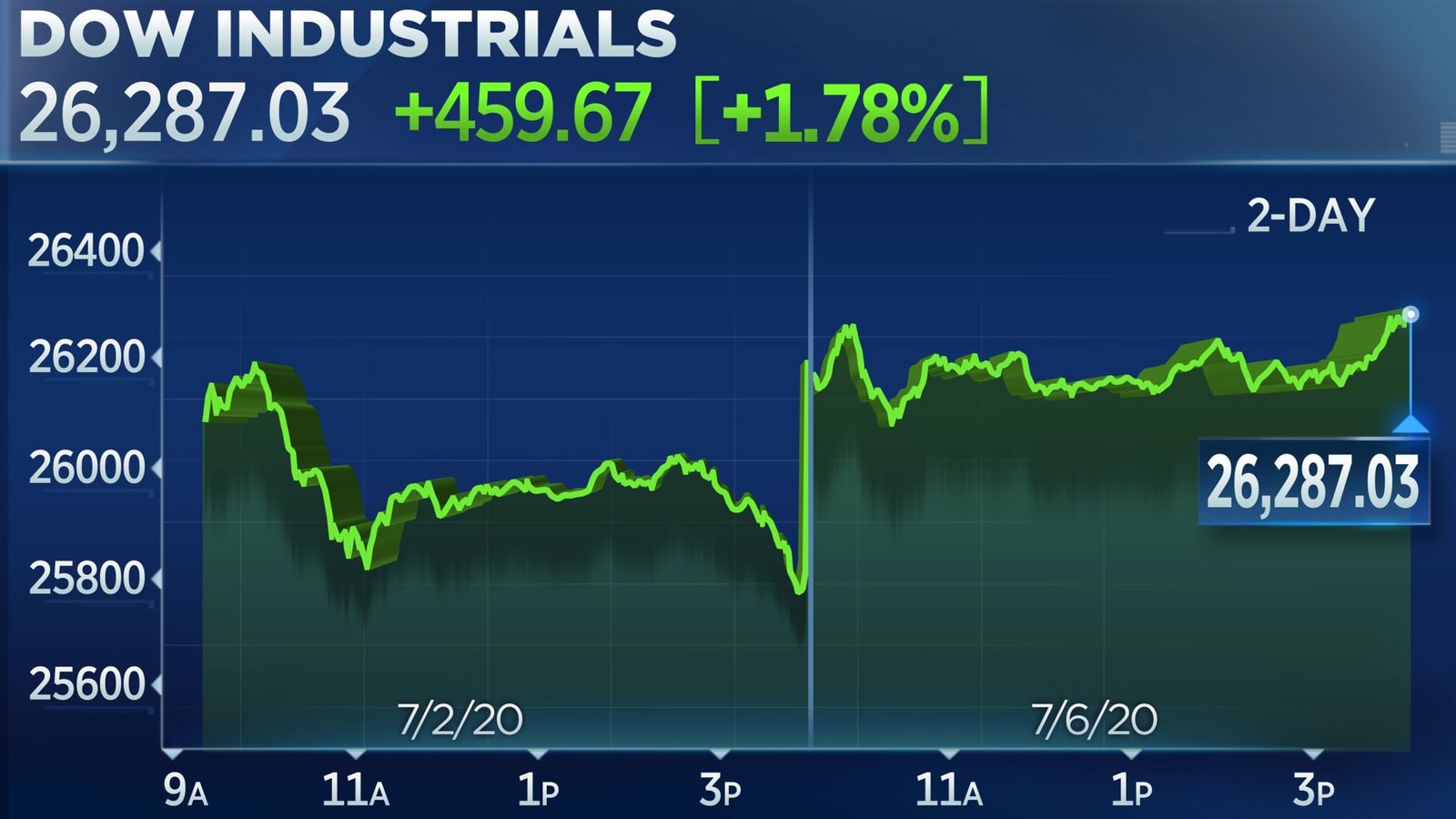

The Dow Jones Industrial Average (DJIA) is one of the world’s most closely followed stock market indexes. Every trading day, millions of investors, analysts, businesses, and financial media outlets monitor its performance to understand the overall direction of the U.S. stock market. Searching for DJIA today has become common among people looking for the latest market movement, economic trends, and investment sentiment.
Created more than a century ago, the DJIA tracks the performance of 30 large, well-established U.S. companies representing various industries. Although it contains only 30 stocks, the index remains an important indicator of investor confidence because its components include some of America’s most influential corporations.
Recent trading sessions have shown the Dow continuing to respond to corporate earnings, inflation data, interest rate expectations, and broader economic developments. On July 15, 2026, the index closed higher at 52,658.64, supported by strong corporate earnings and easing bond yields.
This guide explains how the Dow works, what influences its daily performance, why investors follow DJIA today, and how the index fits into today’s financial markets.
DJIA Today Quick Overview
| Category | Details |
|---|---|
| Full Name | Dow Jones Industrial Average |
| Number of Companies | 30 |
| Market Focus | Large U.S. Blue-Chip Companies |
| Index Type | Price-Weighted Stock Index |
| Established | 1896 |
| Common Purpose | Measures overall U.S. stock market performance |
This overview provides a foundation for understanding why the Dow remains one of the world’s most recognized financial benchmarks.
What Is the DJIA
The Dow Jones Industrial Average is a stock market index that measures the performance of 30 major publicly traded U.S. companies.
Unlike broader indexes that track hundreds of businesses, the Dow focuses on industry-leading corporations with long operating histories and significant influence on the American economy.
Companies included in the index represent sectors such as technology, healthcare, financial services, consumer goods, industrial manufacturing, and energy.
Although the list occasionally changes to reflect the evolving economy, each company is selected because of its importance within its industry.
Investors often use the Dow as a quick indicator of overall market sentiment even though it represents only a portion of the U.S. stock market.
Why Investors Follow DJIA Today
Financial markets change every trading day.
Economic reports, company earnings, geopolitical developments, interest rate decisions, and investor sentiment all influence stock prices.
Because of this constant activity, many people search for DJIA today to understand how the market is reacting to current events.
A rising Dow often reflects growing investor confidence, while a declining Dow may indicate increased caution or uncertainty.
Financial professionals also compare daily Dow performance with other major indexes such as the S&P 500 and Nasdaq Composite to evaluate broader market trends.
Although no single index tells the complete story, the Dow remains one of the most widely quoted indicators of market performance.
How the Dow Jones Industrial Average Works
One feature that distinguishes the Dow from many other indexes is its price-weighted methodology.
In a price-weighted index, companies with higher share prices have a greater influence on the index than companies with lower share prices.
This differs from market-capitalization-weighted indexes, where company size determines influence.
To maintain consistency after stock splits and other corporate actions, the Dow uses a mathematical adjustment known as the Dow Divisor.
This calculation ensures that structural changes do not create artificial movements in the index.
Although the methodology may appear simple, it has remained an important part of financial markets for more than a century.
Companies Included in the DJIA
The Dow contains many of the most recognized companies in the United States.
Its components have included businesses from industries such as technology, healthcare, banking, consumer products, aerospace, retail, and manufacturing.
These companies are generally considered financially established with significant economic influence.
The composition of the index changes occasionally as industries evolve and new market leaders emerge.
Replacing companies allows the Dow to remain relevant while continuing to represent important sectors of the American economy.
Because of the quality of its constituent companies, the Dow is frequently viewed as a benchmark for large-cap U.S. equities.
Factors That Move the DJIA
Many different factors influence daily market performance.
Corporate earnings reports are among the most important drivers because they reveal how individual companies are performing financially.
Interest rate expectations established by the Federal Reserve also influence stock prices.
Lower borrowing costs often encourage business investment, while higher interest rates may reduce economic growth expectations.
Inflation data affects investor sentiment because persistent inflation can influence monetary policy decisions.
Employment reports, consumer spending, manufacturing activity, and gross domestic product figures also contribute to market movements.
International developments, including geopolitical events and global economic conditions, may create additional volatility.
Recent gains in the Dow have been supported by stronger-than-expected corporate earnings and easing bond yields, while investors continue monitoring inflation and Federal Reserve policy expectations.
Recent Market Performance
Market conditions continue changing as investors evaluate economic data and quarterly earnings.
In the latest completed trading session, the Dow Jones Industrial Average finished at 52,658.64, gaining approximately 0.3% as positive earnings reports helped offset broader market uncertainty. Treasury yields also eased, providing additional support for equities.
Analysts remain focused on upcoming corporate earnings, inflation reports, and Federal Reserve communications because these factors may influence future market direction.
While short-term volatility is normal, many long-term investors continue monitoring broader economic fundamentals rather than reacting to daily price movements.
Why the DJIA Matters to the Economy
The Dow serves as more than just a collection of stock prices.
Its performance often reflects investor confidence in major American businesses and the broader economy.
Although it does not represent every publicly traded company, the index includes corporations with substantial economic influence across multiple industries.
Businesses, policymakers, economists, and international investors frequently monitor the Dow when evaluating market conditions.
Financial media also use daily Dow performance to summarize overall market sentiment because the index remains familiar to both experienced investors and the general public.
Understanding the movement of DJIA today provides valuable context for interpreting economic news, corporate performance, and changes in investor confidence.
DJIA Versus the S&P 500 and Nasdaq
Although the Dow Jones Industrial Average is one of the world’s best-known stock indexes, investors often compare it with the S&P 500 and the Nasdaq Composite.
| Index | Number of Companies | Weighting Method | Primary Focus |
|---|---|---|---|
| DJIA | 30 | Price-weighted | Large blue-chip U.S. companies |
| S&P 500 | 500 | Market capitalization | Broad U.S. market |
| Nasdaq Composite | 3,000+ | Market capitalization | Technology and growth-focused companies |
The DJIA provides a snapshot of large, established companies, while the S&P 500 offers broader market coverage. The Nasdaq Composite includes thousands of companies and is generally more influenced by technology stocks.
Many investors monitor all three indexes together because they provide different perspectives on overall market performance.
Advantages of Following the DJIA
The Dow has remained relevant for more than a century because it offers several important benefits.
Its focus on large, financially established companies makes it easy for investors to understand overall market direction.
Daily movements are widely reported by financial news organizations, making the index one of the most accessible market indicators.
Because its components represent major sectors of the U.S. economy, the index often reflects changing business conditions and investor confidence.
Long-term historical data also allows analysts to compare current performance with previous economic cycles, recessions, and bull markets.
For beginners, the Dow serves as a useful starting point for learning about financial markets before exploring more specialized investment strategies.
Limitations of the DJIA
Despite its popularity, the Dow also has several limitations.
The index includes only 30 companies, meaning it cannot fully represent the entire U.S. stock market.
Its price-weighted calculation gives higher-priced stocks greater influence than lower-priced stocks, regardless of each company’s total market value.
Many fast-growing businesses and smaller public companies are not included in the index.
Technology companies have become increasingly important to the U.S. economy, yet broader indexes often provide greater exposure to this sector than the Dow.
For these reasons, many professional investors use the DJIA together with other indexes rather than relying on it alone.
How Investors Can Use DJIA Today
Monitoring DJIA today can help investors better understand changing market conditions.
Daily movements often provide insight into investor sentiment following economic reports, earnings announcements, or central bank decisions.
Long-term investors usually focus on overall market trends instead of reacting to every daily price fluctuation.
Short-term traders may monitor the Dow alongside technical indicators, trading volume, and broader economic news.
Regardless of investment style, understanding why the market moves is generally more valuable than simply observing whether the index rises or falls.
Successful investing typically depends on disciplined planning, diversification, and long-term financial goals rather than short-term market headlines.
Outlook for the Dow Jones Industrial Average
The future performance of the Dow will continue to depend on corporate earnings, inflation trends, Federal Reserve policy, consumer spending, labor market conditions, and global economic developments.
Analysts expect investors to remain focused on quarterly earnings reports and future interest-rate decisions, both of which can significantly influence market direction. Continued strength in corporate profits could support equities, while unexpected economic weakness or persistent inflation may increase volatility.
Although short-term fluctuations are inevitable, the Dow has historically demonstrated resilience through changing economic environments.
Investors who maintain diversified portfolios and evaluate long-term economic fundamentals are generally better positioned to navigate periods of market uncertainty.
Final Thoughts
The Dow Jones Industrial Average remains one of the world’s most influential stock market indexes and continues to provide valuable insight into the performance of large U.S. companies. Whether markets rise or fall, tracking DJIA today helps investors understand how economic news, corporate earnings, inflation, and monetary policy affect financial markets.
While the index represents only 30 companies, its long history and inclusion of leading blue-chip businesses make it an important benchmark for measuring investor confidence. At the latest close, the Dow finished at 52,658.64, supported by positive corporate earnings and lower Treasury yields, highlighting how quickly market sentiment can respond to economic developments.
For both new and experienced investors, following the Dow alongside broader indexes such as the S&P 500 and Nasdaq provides a more complete picture of the U.S. stock market. Combining market knowledge with disciplined investing and long-term planning remains one of the most effective ways to navigate changing financial conditions.
Frequently Asked Questions
1. What does DJIA stand for?
DJIA stands for the Dow Jones Industrial Average, a stock market index that tracks 30 major publicly traded U.S. companies.
2. Why do people search for DJIA today?
People search for DJIA today to check the latest market performance, monitor investor sentiment, and understand how economic events are affecting the stock market.
3. How often does the DJIA change?
The index updates continuously during U.S. market trading hours, while its list of component companies changes only occasionally when necessary.
4. Is the DJIA a good indicator of the U.S. economy?
The Dow provides a useful snapshot of large American companies, but many investors also follow the S&P 500 and Nasdaq for a broader view of overall market performance.
5. What factors influence the DJIA the most?
Corporate earnings, Federal Reserve interest-rate decisions, inflation, employment reports, geopolitical developments, and overall investor sentiment are among the biggest factors affecting the Dow’s daily movement.