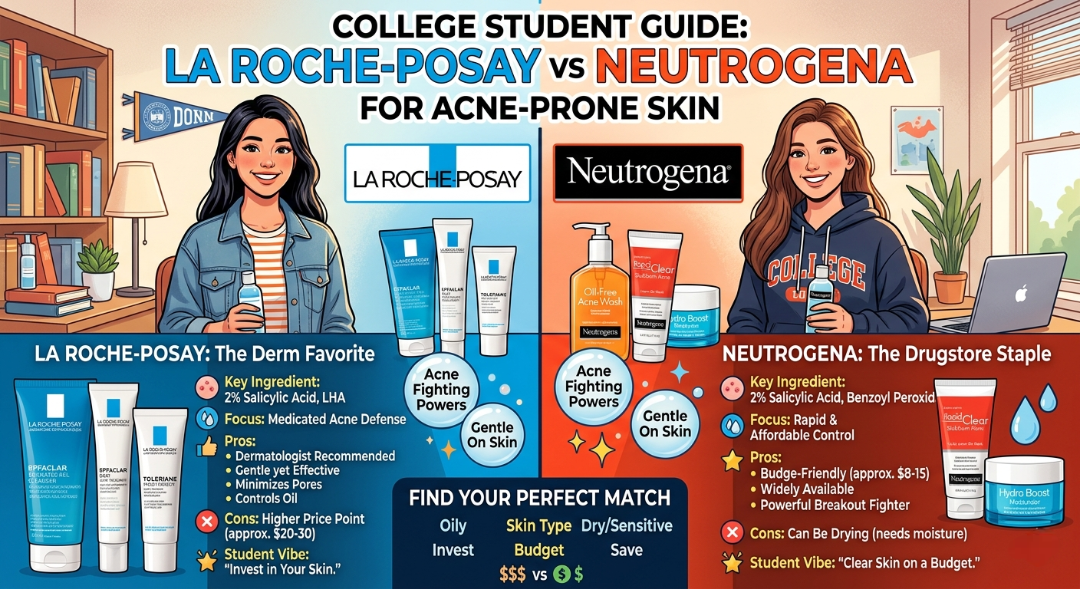

If you’re a college student struggling with breakouts, you’ve probably searched late at night for solutions like “what actually works for acne-prone skin?” and ended up stuck between two big skincare names: La Roche-Posay and Neutrogena.
Both brands are widely recommended, both are dermatologist-approved, and both promise clearer skin but they are not identical. Their formulations, philosophy, and price points differ in ways that can seriously impact your results.
So the real question becomes:
i am a college student. are la roche-posay products better for acne-prone skin than neutrogena?
The honest answer is: it depends on your skin type, acne severity, and consistency but one brand does have a slight edge in specific scenarios.
In this in-depth guide, we’ll break down everything you need to know using real ingredient analysis, dermatologist-backed insights, and practical student-friendly advice so you can confidently choose what actually works for your skin not just what’s trending on social media.
Understanding Acne-Prone Skin in College Students
College life is one of the most common periods for acne flare-ups. Why?
Main triggers include:
- Stress from exams and deadlines
- Irregular sleep schedules
- High sugar or fast-food diets
- Hormonal fluctuations (especially in early 20s)
- Inconsistent skincare routines
- Sweat, pollution, and dorm environment bacteria
Acne in college students is usually a mix of:
- Comedonal acne (blackheads, whiteheads)
- Inflammatory acne (red pimples, pustules)
- Occasional hormonal breakouts
This means your skincare routine must balance:
- Oil control
- Gentle hydration
- Barrier protection
- Active acne treatment
Both La Roche-Posay and Neutrogena target these needs—but in different ways.
Brand Overview: La Roche-Posay vs Neutrogena
La Roche-Posay: Dermatology-First Skincare
La Roche-Posay is a French dermocosmetic brand heavily recommended by dermatologists, especially for sensitive and acne-prone skin.
Key strengths:
- High focus on sensitive skin safety
- Minimalistic, fragrance-conscious formulas
- Strong use of soothing ingredients like thermal spring water
- Excellent barrier repair products
Popular acne-related lines:
- Effaclar (oil control + acne treatment)
- Toleriane (sensitive, acne-safe hydration)
- Cicaplast (skin barrier recovery)
Neutrogena: Accessible Acne-Fighting Brand
Neutrogena is a widely available skincare brand known for affordability and strong active ingredients.
Key strengths:
- Budget-friendly for students
- Strong acne-fighting actives like salicylic acid
- Easy availability in drugstores
- Wide product range (cleansers, moisturizers, treatments)
Popular acne-related lines:
- Oil-Free Acne Wash
- Rapid Clear Treatment
- Hydro Boost (hydration support)
- Some adapalene-based treatments (in select markets)
Ingredient Comparison: The Real Difference
If you want to know which brand is better, you must look beyond marketing and focus on ingredients.
1. Salicylic Acid (BHA)
Used for unclogging pores and reducing blackheads.
- Neutrogena: Uses it aggressively in cleansers and spot treatments
- La Roche-Posay: Uses it more gently, often combined with soothing agents
✔ Winner for fast exfoliation: Neutrogena
✔ Winner for sensitive skin use: La Roche-Posay
2. Benzoyl Peroxide
Kills acne-causing bacteria.
- Neutrogena: Common in Rapid Clear products
- La Roche-Posay: Used more strategically, often in combination formulas
✔ Winner for strong acne treatment: Neutrogena
3. Niacinamide
Helps reduce redness and strengthen skin barrier.
- La Roche-Posay: Frequently included (especially Effaclar range)
- Neutrogena: Present in some products but less central
✔ Winner: La Roche-Posay
4. Skin Barrier Support
This is where differences become more noticeable.
- La Roche-Posay: Strong focus on barrier repair (ceramides, thermal water)
- Neutrogena: More focused on acne removal than long-term barrier health
✔ Winner: La Roche-Posay
Which Brand Works Better for Acne-Prone Skin?
Let’s answer the key question directly.
If you have mild acne (blackheads, oily skin):
Neutrogena may work faster
Why:
- Strong salicylic acid cleansers
- Deep pore cleansing
- Affordable trial-and-error options
If you have sensitive or irritated acne-prone skin:
La Roche-Posay is usually better
Why:
- Less irritation risk
- Better hydration balance
- Stronger barrier protection
If you have moderate to severe acne:
A combination approach works best
Dermatologists often suggest:
- Neutrogena for active acne treatment
- La Roche-Posay for hydration + recovery
College Student Perspective: Budget vs Results
Let’s be realistic—students care about two things:
1. Budget
- Neutrogena: ₹300–₹900 range (generally affordable)
- La Roche-Posay: ₹800–₹2500+ range (premium pricing)
2. Consistency
Skincare only works when used regularly.
What students often struggle with:
- Buying expensive products but not using them consistently
- Overusing strong acne treatments
- Switching products too often
Smart Student Strategy:
Instead of choosing one brand blindly:
Morning routine:
- Gentle cleanser (La Roche-Posay or mild Neutrogena)
- Lightweight moisturizer
- Sunscreen (non-negotiable)
Night routine:
- Salicylic acid or benzoyl peroxide treatment (Neutrogena advantage)
- Barrier repair moisturizer (La Roche-Posay advantage)
Dermatologist-Style Insight (EEAT Perspective)
Dermatologists generally do not recommend brands they recommend ingredients and routines.
However, in clinical practice patterns:
- La Roche-Posay is often recommended for:
- Sensitive acne-prone skin
- Post-acne redness
- Skin barrier damage
- Neutrogena is often recommended for:
- Oily skin with active breakouts
- Teen and young adult acne
- Budget-conscious patients needing OTC treatment
The takeaway:
Dermatologists often use both approaches depending on skin condition
Common Mistakes College Students Make with Acne Skincare
Even the best products fail if used incorrectly.
Mistakes to avoid:
- Over-washing face (strips skin barrier)
- Mixing too many actives (causes irritation)
- Skipping sunscreen
- Expecting results in 2–3 days
- Switching brands too quickly
What Works Best: A Balanced Routine
If you are confused between La Roche-Posay and Neutrogena, here is a practical routine:
Simple Acne-Control Routine
Morning:
- Gentle cleanser (either brand, avoid harsh scrubs)
- Lightweight moisturizer
- SPF 30+ sunscreen
Night:
- Salicylic acid cleanser (Neutrogena works well here)
- Acne treatment (benzoyl peroxide or adapalene if prescribed)
- Hydrating moisturizer (La Roche-Posay ideal)
This combination often delivers better results than sticking to just one brand.
So, Are La Roche-Posay Products Better Than Neutrogena?
Let’s answer clearly:
La Roche-Posay is better if:
- You have sensitive or irritated acne
- You want long-term skin health
- Your skin reacts easily to strong actives
Neutrogena is better if:
- You want faster oil control
- You are dealing with mild to moderate acne
- You are on a student budget
Final Verdict:
Neither brand is universally “better”
The winner depends on your skin type and routine consistency
Featured Snippet Summary
Best choice for acne-prone college students:
- Neutrogena = stronger acne-fighting actives + budget-friendly
- La Roche-Posay = gentler, skin-barrier-focused, dermatologist-friendly
- Best results = combining both strategically based on skin needs
Conclusion
Choosing between La Roche-Posay and Neutrogena is not about finding a “perfect brand” it’s about understanding your skin’s needs.
If you are a college student dealing with acne, stress, and an unpredictable routine, the smartest approach is not picking one brand over the other but learning how to use both strategically.
Neutrogena helps fight acne aggressively and affordably, while La Roche-Posay supports healing, hydration, and long-term skin balance.
When used correctly, both can work extremely well but your consistency will always matter more than the brand you choose.
FAQs
1. Is La Roche-Posay good for acne-prone skin?
Yes, it is highly recommended for acne-prone and sensitive skin due to its gentle, barrier-supporting formulas.
2. Is Neutrogena good for acne?
Yes, especially for oily and mild acne skin types because it contains strong active ingredients like salicylic acid and benzoyl peroxide.
3. Can I use both La Roche-Posay and Neutrogena together?
Yes, many dermatologists suggest combining them—treat acne with Neutrogena and repair skin with La Roche-Posay.
4. Which brand is better for oily skin?
Neutrogena is often more effective for oil control and deep cleansing.
5. Which brand is better for sensitive skin?
La Roche-Posay is generally safer for sensitive or irritated acne-prone skin.
6. How long does acne treatment take to show results?
Typically 4–8 weeks of consistent use is needed for visible improvement.
7. What is the biggest skincare mistake college students make?
Overusing harsh acne products and not maintaining a consistent routine.