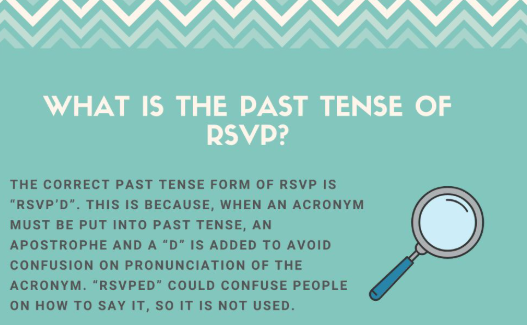

If you’ve come across the term RSVP’d, you may be wondering what it means and whether it is grammatically correct. The word RSVP’d is a common informal written form of the verb RSVP, meaning that someone has already responded to an invitation.
You’ll often see this term in emails, text messages, event planning apps, and social media conversations. Understanding how to use RSVP’d correctly can help you communicate more clearly when discussing invitations or event attendance.
This guide explains the meaning of RSVP’d, its origin, proper grammar, examples, and common mistakes.
What Does RSVP’d Mean?
RSVP’d means responded to an invitation.
It indicates that a person has already informed the event organizer whether they will attend or not.
For example:
- I RSVP’d for the wedding yesterday.
- She RSVP’d to the birthday party.
- Everyone has RSVP’d except one guest.
In each sentence, RSVP’d means the person has already replied to the invitation.
What Does RSVP Stand For?
RSVP comes from the French phrase:
“Répondez s’il vous plaît.”
It translates to:
“Please respond.”
The phrase has been used on invitations for many years to ask guests to confirm whether they will attend an event.
Today, RSVP is commonly used in English-speaking countries for weddings, parties, business meetings, conferences, and other special occasions.
Is RSVP’d Grammatically Correct?
Yes.
Although RSVP originated as an abbreviation, English speakers commonly use it as a verb.
Adding ‘d creates the past tense.
Examples include:
- I RSVP’d yesterday.
- They RSVP’d immediately.
- She hasn’t RSVP’d yet.
This usage is widely accepted in informal and professional communication.
How to Use RSVP’d in a Sentence
Here are some correct examples:
- I RSVP’d as soon as I received the invitation.
- We RSVP’d for the charity event.
- Have you RSVP’d yet?
- Everyone RSVP’d before the deadline.
- He RSVP’d online.
These sentences are natural and commonly used in everyday English.
RSVP vs RSVP’d
Many people confuse these two forms.
| Word | Meaning |
|---|---|
| RSVP | Please respond or to respond to an invitation |
| RSVP’d | Already responded to an invitation |
Examples:
- Please RSVP by Friday.
- I RSVP’d last week.
The first sentence is a request.
The second describes a completed action.
When Should You Use RSVP’d?
You can use RSVP’d when talking about a response that has already happened.
Common situations include:
- Wedding invitations
- Birthday parties
- Graduation ceremonies
- Corporate events
- Conferences
- Family gatherings
- Baby showers
- Dinner parties
It helps indicate that someone has confirmed their attendance or declined the invitation.
Common Mistakes
Avoid these mistakes:
Writing RSVP Without the Past Tense
Incorrect:
- I RSVP yesterday.
Correct:
- I RSVP’d yesterday.
Confusing RSVP With Attendance
RSVP only means someone responded.
It does not necessarily mean they attended the event.
Someone may RSVP “No” and still have RSVP’d.
Forgetting the Apostrophe
Most style guides accept RSVP’d, although some publications also use RSVPed.
Both forms are seen in modern English, but RSVP’d is especially common in informal writing.
Tips for Using RSVP’d Correctly
To use the word naturally:
- Use it only for completed responses.
- Mention the event when appropriate.
- Use it in emails, texts, and conversations.
- Respond before the RSVP deadline.
- Be clear if you are accepting or declining the invitation.
Following these tips helps avoid confusion.
Why RSVP Is Important
Responding to invitations helps event organizers:
- Plan seating arrangements.
- Prepare food and beverages.
- Estimate attendance.
- Manage event budgets.
- Organize schedules.
- Provide a better guest experience.
Prompt RSVPs are considered polite and professional.
Final Thoughts
RSVP’d simply means that someone has already responded to an invitation. It is a widely accepted past-tense form of RSVP and is commonly used in emails, text messages, invitations, and everyday conversations. Whether you’re attending a wedding, business meeting, birthday party, or conference, using RSVP’d correctly helps communicate that your response has already been sent.
Frequently Asked Questions
What does RSVP’d mean?
RSVP’d means someone has already responded to an invitation.
Is RSVP’d grammatically correct?
Yes. It is a commonly accepted past-tense form of RSVP.
What does RSVP stand for?
It stands for the French phrase “Répondez s’il vous plaît,” meaning “Please respond.”
Is RSVP’d formal?
Yes. It is acceptable in both professional and informal communication, although some formal publications may prefer RSVPed.
Does RSVP’d mean someone is attending?
Not necessarily. It only means they responded. They may have accepted or declined the invitation.
Can I write RSVPed instead of RSVP’d?
Yes. Both RSVP’d and RSVPed are used in English, depending on the style guide or personal preference.
When should I RSVP?
You should respond before the RSVP deadline listed on the invitation.
Where is RSVP commonly used?
It is commonly used for weddings, parties, business meetings, conferences, school events, and other gatherings.
Why is RSVP important?
It helps organizers plan seating, catering, schedules, and other event details accurately.
Can RSVP be used as a verb?
Yes. In modern English, RSVP is commonly used as a verb, such as “Please RSVP” or “I RSVP’d yesterday.”