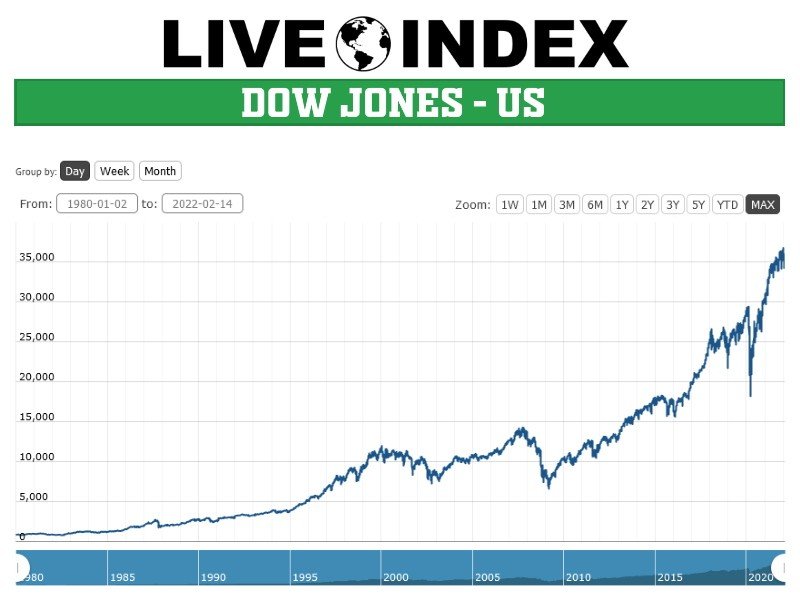

The global financial market depends on reliable indicators that help investors understand economic conditions, business performance, and market confidence. Among all major stock market benchmarks, the Dow Jones Index remains one of the most recognized and influential financial measurements in the world. Investors, analysts, businesses, and financial institutions closely follow its movements to understand how some of America’s largest companies are performing.
The Dow Jones Index, officially known as the Dow Jones Industrial Average (DJIA), represents 30 leading publicly traded companies from different sectors of the U.S. economy. These companies include some of the most established names in technology, healthcare, finance, consumer products, and industrial industries.
Unlike broader indexes that track hundreds or thousands of companies, the Dow focuses on major blue-chip businesses with strong reputations and significant economic influence. Because of its long history and global recognition, it continues to be an important indicator of investor sentiment and market direction.
This comprehensive guide explains the history, working process, importance, major components, advantages, limitations, and future relevance of the Dow Jones Index while helping readers understand why this benchmark remains essential in modern investing.
Dow Jones Index Quick Overview
| Category | Details |
|---|---|
| Official Name | Dow Jones Industrial Average |
| Common Short Name | DJIA or Dow |
| Founded | 1896 |
| Created By | Charles Dow and Edward Jones |
| Number of Companies | 30 Major U.S. Companies |
| Index Type | Price-Weighted Index |
| Main Purpose | Tracks performance of leading U.S. businesses |
This overview highlights the basic structure of one of the oldest and most followed stock market indexes.
What Is The Dow Jones Index
The Dow Jones Index is a stock market benchmark that measures the performance of 30 large and influential companies listed on U.S. stock exchanges.
It was originally created to track industrial companies during a period when manufacturing played a major role in the American economy. Over time, the index evolved to include businesses from various modern industries.
Today, companies included in the Dow represent different parts of the economy, including technology, financial services, healthcare, retail, entertainment, and manufacturing.
The purpose of the index is not to represent every publicly traded company but to provide a snapshot of how major American corporations are performing.
Because the companies included in the index have significant market influence, changes in the Dow are often viewed as a reflection of investor confidence and economic expectations.
History And Evolution Of The Dow Jones Index
The Dow Jones Index was introduced on May 26, 1896, by financial journalist Charles Dow and statistician Edward Jones.
When it was first launched, the index contained only 12 companies. These businesses mainly represented industrial sectors that were driving economic growth at the time.
As the U.S. economy transformed, the index also changed. New industries emerged, technology became more important, and consumer behavior evolved.
The number of companies increased from the original 12 to 30, creating a broader representation of major American businesses.
Throughout its history, the Dow has experienced major economic events, including financial crises, recessions, market recoveries, and periods of strong growth.
Its ability to survive and adapt for more than a century has made it one of the most respected financial benchmarks worldwide.
How The Dow Jones Index Works
The calculation method of the Dow makes it different from many other stock market indexes.
The Dow is a price-weighted index, meaning companies with higher stock prices have a greater influence on the index’s movement.
For example, a company with a higher share price will impact the Dow more significantly than a company with a lower share price, even if the lower-priced company has a larger total market value.
To maintain accuracy after events such as stock splits, mergers, or other corporate changes, the index uses a special calculation adjustment called the Dow Divisor.
The Dow Divisor ensures that structural changes do not create artificial increases or decreases in the index value.
Although some modern investors prefer market-cap-weighted indexes, the Dow’s calculation method has remained an important part of its identity.
Companies Included In The Dow Jones Index
The companies included in the Dow are considered some of the strongest and most established businesses in the United States.
These organizations are selected based on factors such as reputation, industry importance, financial stability, and economic influence.
The index includes companies from multiple sectors, which helps provide a broader view of large-scale business performance.
Common industries represented in the Dow include:
- Technology
- Healthcare
- Banking and financial services
- Consumer products
- Industrial manufacturing
- Telecommunications
- Energy-related businesses
The companies included in the index can change over time as the economy develops and new market leaders emerge.
This adjustment process helps maintain the relevance of the Dow in a rapidly changing business environment.
Why Investors Follow The Dow Jones Index
The Dow remains popular because it provides a simple way to understand market conditions.
Millions of investors check Dow performance daily to evaluate whether confidence in major companies is increasing or declining.
A rising Dow often suggests positive investor sentiment, stronger corporate expectations, or improving economic conditions.
A falling Dow may indicate concerns about inflation, interest rates, economic slowdown, or global uncertainty.
However, experienced investors understand that one index cannot explain the entire market.
The Dow is usually analyzed alongside other benchmarks such as the S&P 500 and Nasdaq Composite to gain a more complete understanding of market performance.
Tracking the Dow helps investors connect financial news with broader economic trends.
Factors That Influence The Dow Jones Index
Several economic and market factors affect the daily movement of the Dow.
Corporate earnings are among the most important influences because they show whether companies are growing, maintaining profitability, or facing challenges.
Interest rate decisions from the Federal Reserve also have a major impact. Higher rates can affect borrowing costs, business expansion, and investor behavior.
Inflation data influences expectations about monetary policy and consumer purchasing power.
Employment reports, manufacturing activity, consumer spending, and economic growth figures also contribute to market movements.
Global events, including geopolitical developments and international economic changes, can create additional market volatility.
Because Dow companies operate globally, worldwide economic conditions can influence their performance and investor expectations.
Importance Of The Dow For The Financial World
The Dow Jones Index plays an important role beyond daily market reporting.
Financial institutions use it as a reference point when analyzing economic trends and investment performance.
Media organizations frequently mention the Dow when explaining market movements to the general public.
Businesses and policymakers also monitor major indexes because they provide insight into economic confidence.
Although the Dow represents only 30 companies, its historical importance and connection with leading corporations make it one of the most influential market indicators in the world.
Dow Jones Index Compared With S&P 500 And Nasdaq
The Dow Jones Index is one of the most recognized stock market benchmarks, but investors often compare it with other major indexes to understand different areas of the financial market.
| Index | Number Of Companies | Calculation Method | Main Focus |
|---|---|---|---|
| Dow Jones Industrial Average | 30 | Price-weighted | Large U.S. blue-chip companies |
| S&P 500 | 500 | Market capitalization-weighted | Broad U.S. stock market performance |
| Nasdaq Composite | 3,000+ | Market capitalization-weighted | Technology and growth companies |
The Dow focuses on well-established corporations with strong market positions. The S&P 500 provides a wider view of American businesses, while the Nasdaq mainly highlights technology and innovation-driven companies.
Professional investors often study all three indexes together because each benchmark provides different information about market conditions.
Benefits Of Tracking The Dow Jones Index
The Dow remains popular among investors because it provides several important advantages.
One major benefit is its long history. Since 1896, the index has recorded decades of market cycles, economic changes, and business transformations.
This historical data allows analysts to compare current market conditions with previous periods of growth, uncertainty, and recovery.
Another advantage is simplicity. Since the index contains only 30 companies, beginners can more easily understand how major corporations influence market movements.
The Dow also focuses on financially strong companies with established business models, making it a useful indicator of large-cap corporate performance.
Because financial media regularly reports Dow movements, investors can easily follow market discussions and economic trends.
Limitations Of The Dow Jones Index
Despite its importance, the Dow Jones Index has some limitations that investors should understand.
The biggest limitation is the number of companies included. With only 30 companies, the index does not represent the complete U.S. stock market.
Thousands of smaller businesses and emerging companies are not included, meaning the Dow may not fully reflect every part of the economy.
Another limitation is the price-weighted structure. A company with a higher share price can influence the index more than another company with a larger overall market value.
Some investors believe market-capitalization-weighted indexes provide a more accurate representation of market size and economic importance.
For this reason, many professionals use the Dow together with broader benchmarks to create a complete market analysis.
How Beginners Can Use The Dow For Learning
For people new to investing, the Dow Jones Index can be an excellent educational tool.
Following daily movements helps beginners understand how economic news, company earnings, interest rates, and investor sentiment influence stock prices.
However, beginners should avoid making investment decisions based only on whether the Dow rises or falls on a particular day.
Markets naturally experience short-term changes, and successful investing usually requires patience, research, and proper risk management.
Learning how the Dow works can help new investors understand important concepts such as market cycles, diversification, and long-term financial planning.
The index provides a simple entry point into the larger world of investing.
Role Of The Dow In Global Financial Markets
Although the Dow tracks American companies, its influence extends across international markets.
Many companies included in the index operate worldwide, meaning their performance can affect businesses and investors in different countries.
International investors often monitor Dow movements because the United States remains one of the largest and most influential economies globally.
Major changes in the index can influence market sentiment around the world, especially during important economic events.
The Dow also serves as a reference point for financial discussions, investment reports, and economic analysis.
Its global recognition demonstrates the lasting importance of this century-old benchmark.
Future Outlook Of The Dow Jones Index
The future performance of the Dow will depend on several major factors, including corporate earnings, inflation trends, interest rate policies, consumer spending, and global economic conditions.
As technology, artificial intelligence, healthcare innovation, and changing consumer behavior continue shaping the economy, the companies included in the index may also evolve.
The Dow has successfully adapted for more than 100 years by changing its components when necessary.
Future adjustments will likely continue to ensure that the index represents important sectors of the modern economy.
Although short-term market movements can be unpredictable, the long-term history of the Dow demonstrates resilience through different economic environments.
Investors will continue using the index as an important tool for understanding market confidence and business performance.
How The Dow Builds Investor Confidence
Market indexes play an important psychological role in investing, and the Dow is one of the strongest examples.
When investors see positive Dow performance, it can create confidence about corporate growth and economic stability.
During challenging periods, declining Dow levels may reflect uncertainty among investors.
However, experienced market participants understand that temporary movements are normal and do not always indicate long-term economic problems.
The Dow provides valuable information, but investors should combine it with company research, economic analysis, and broader financial planning.
Using multiple sources of information helps create better investment decisions.
Final Thoughts
The Dow Jones Index remains one of the most powerful and trusted financial benchmarks in the world. For more than a century, it has provided insight into the performance of leading American companies and helped investors understand changing market conditions.
Although the index tracks only 30 companies and follows a price-weighted calculation method, its historical importance, global recognition, and connection with major corporations continue making it highly valuable.
Understanding the Dow helps investors interpret financial news, analyze economic trends, and develop a stronger understanding of stock markets. However, it should be viewed as one part of a broader investment analysis strategy rather than the only measure of market performance.
For beginners, professionals, and financial observers, learning about the Dow Jones Index provides a strong foundation for understanding how modern markets operate and how major companies influence the global economy.
Frequently Asked Questions
1. What is the Dow Jones Index?
The Dow Jones Index, also called the Dow Jones Industrial Average, is a stock market benchmark that tracks the performance of 30 major U.S. companies.
2. Why is the Dow Jones Index important?
The index is important because it reflects the performance of leading American businesses and provides insight into investor confidence and market trends.
3. How is the Dow calculated?
The Dow uses a price-weighted calculation method where companies with higher stock prices have a greater influence on index movement.
4. Is the Dow Jones Index the same as the stock market?
No. The Dow represents only 30 major companies, while the overall stock market includes thousands of publicly traded businesses.
5. Which is better between the Dow and S&P 500?
Neither is always better. The Dow focuses on large blue-chip companies, while the S&P 500 provides broader market coverage with 500 companies.
6. Can beginners learn investing through the Dow?
Yes. The Dow is a useful starting point for understanding market movements, economic factors, and how major companies influence financial markets.