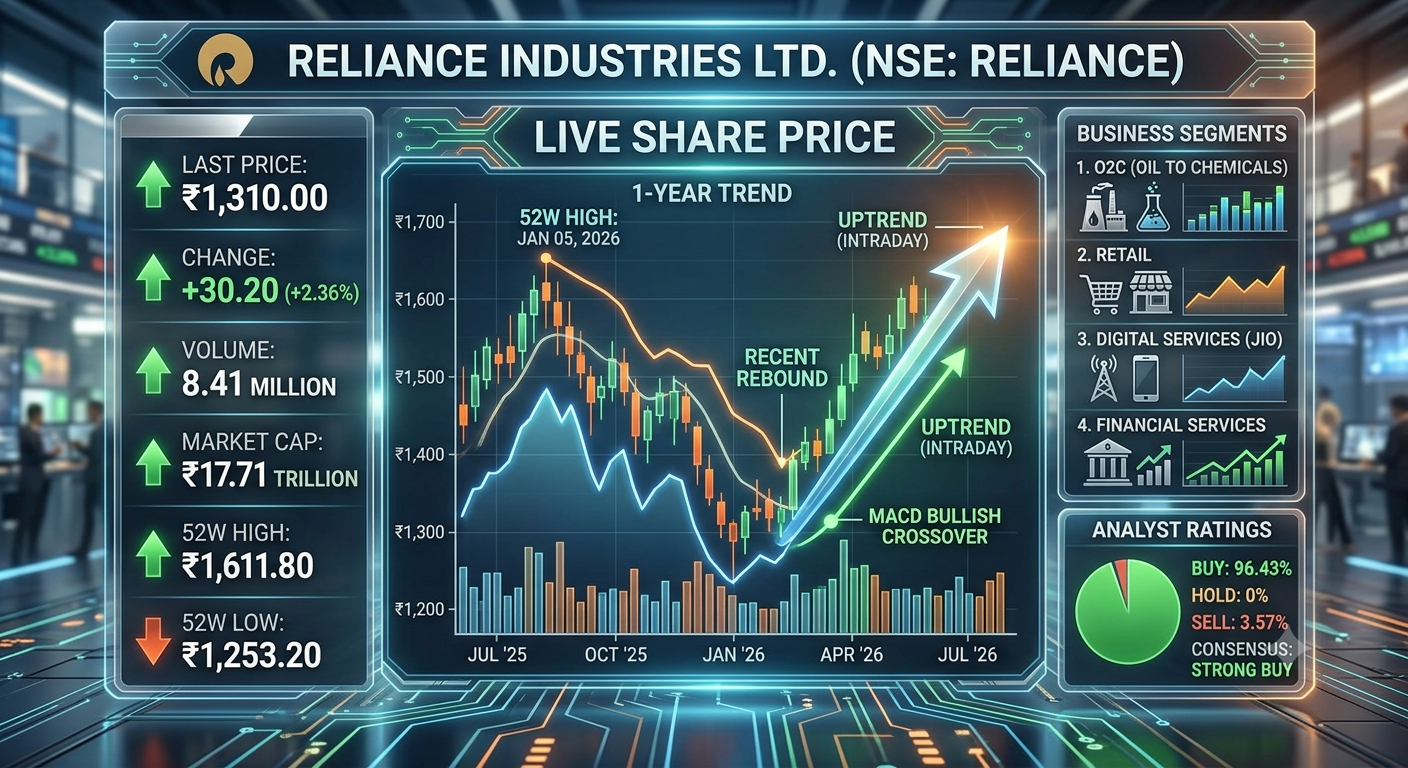

The Reliance share price is one of the most closely watched stock prices in the Indian market. As the flagship company of the Reliance Group, Reliance Industries Limited (RIL) has built a diversified business spanning energy, petrochemicals, telecommunications, retail, digital services, media, and renewable energy. Its size and influence make it a major component of benchmark indices such as the Nifty 50 and Sensex.
Because of its broad business portfolio and consistent expansion into new industries, Reliance often attracts long-term investors as well as short-term traders. This guide explains the company’s business model, the factors that influence its share price, historical performance, financial strengths, potential risks, and what investors should know before buying the stock.
Overview of Reliance Industries
Reliance Industries Limited is one of India’s largest publicly listed companies by market capitalization. Founded by Dhirubhai Ambani and currently led by Mukesh Ambani, the company has transformed from a textile manufacturer into a diversified conglomerate.
Its major business segments include:
- Oil-to-Chemicals (O2C)
- Refining
- Petrochemicals
- Reliance Retail
- Jio Platforms
- Digital Services
- New Energy
- Renewable Power
This diversified structure helps reduce dependence on any single business segment.
Latest Share Price Snapshot
As of 10 July 2026, Reliance Industries closed at approximately ₹1,307.80 per share. The stock was about 18.9% below its 52-week high of ₹1,611.80 and around 4.4% above its 52-week low of ₹1,253.20.
Keep in mind that stock prices change throughout each trading session, so investors should check live market data before making investment decisions.
Why Investors Follow Reliance Share Price
Reliance plays a significant role in India’s economy.
Investors monitor the stock because of:
- Large market capitalization
- Strong institutional ownership
- Diversified revenue sources
- Consistent business expansion
- Index weight in Nifty and Sensex
- Regular strategic investments
Movements in Reliance shares often influence the broader Indian stock market.
Business Segments Driving Growth
Oil-to-Chemicals
The O2C business remains one of the company’s largest revenue contributors.
It includes:
- Petroleum refining
- Petrochemical manufacturing
- Fuel exports
- Industrial chemicals
Global crude oil prices and refining margins significantly affect this segment.
Jio Platforms
Jio transformed India’s telecommunications industry through affordable data services.
Growth areas include:
- Mobile subscribers
- Fiber broadband
- Enterprise solutions
- Cloud services
- Artificial intelligence initiatives
Reliance Retail
Reliance Retail has become one of India’s largest retail businesses.
Operations include:
- Grocery stores
- Fashion
- Electronics
- E-commerce
- Consumer brands
Its continued expansion supports long-term revenue growth.
New Energy
Reliance is investing heavily in renewable energy through projects involving:
- Solar manufacturing
- Green hydrogen
- Battery storage
- Clean energy infrastructure
These initiatives are expected to become increasingly important over the coming years.
Factors That Influence Reliance Share Price
Several variables affect the stock’s performance.
Quarterly Earnings
Strong revenue and profit growth generally improve investor confidence.
The company has announced that its board will meet on 17 July 2026 to consider the June-quarter financial results, making the upcoming earnings a key event for investors.
Crude Oil Prices
Changes in global oil prices impact refining and petrochemical profitability.
Retail Performance
Growth in store expansion, sales, and consumer spending influences market sentiment.
Telecom Growth
Subscriber additions, digital services, and average revenue per user (ARPU) remain important indicators for Jio.
Market Conditions
Overall stock market sentiment also affects Reliance shares.
Factors include:
- Interest rates
- Inflation
- Global economic conditions
- Foreign institutional investment
- Government policies
Historical Performance
Reliance has delivered substantial long-term growth over several decades, although like all stocks, it has experienced periods of volatility.
Historically, growth has been supported by:
- Business diversification
- Strategic acquisitions
- Expansion into digital services
- Retail leadership
- Continuous capital investment
Long-term investors generally focus on business fundamentals rather than short-term price fluctuations.
Dividend History
Reliance has paid dividends to shareholders, although it is generally viewed as a growth-oriented company rather than a high-dividend stock.
Dividend decisions depend on:
- Annual profits
- Cash flow
- Capital expenditure plans
- Board approval
Financial Strengths
Investors often cite several strengths.
- Diversified business model
- Strong brand recognition
- Large customer base
- Leadership in telecom
- Expanding retail operations
- Significant investment in future technologies
These characteristics contribute to long-term investor confidence.
Risks Investors Should Consider
Every investment carries risk.
Potential challenges include:
- Fluctuating crude oil prices
- Global economic slowdown
- Regulatory changes
- Increased competition
- Large capital expenditure requirements
- Market volatility
Diversification across industries helps reduce some risks but cannot eliminate them entirely.
Analyst Outlook
Market analysts continue to monitor Reliance closely because of its strong position across multiple industries. Consensus estimates cited by market trackers indicate an average target price around ₹1,666, implying potential upside from recent trading levels, though targets vary between brokerages and are not guarantees of future performance.
Investors should use analyst reports as one input among many and conduct their own research before investing.
Should You Invest in Reliance?
Reliance may appeal to investors seeking exposure to:
- India’s economic growth
- Telecommunications
- Retail
- Energy
- Renewable energy
- Digital infrastructure
Before investing, consider:
- Your investment horizon
- Risk tolerance
- Portfolio diversification
- Financial goals
- Current market valuation
Long-term investors typically evaluate business quality in addition to short-term share price movements.
Tips for New Investors
If you’re considering investing in Reliance, keep these best practices in mind:
- Research the company’s financial statements.
- Review quarterly earnings reports.
- Follow major business announcements.
- Diversify your portfolio.
- Invest according to your financial goals.
- Avoid making decisions based solely on daily price movements.
Frequently Asked Questions
Why is Reliance share price important?
Reliance Industries is one of India’s largest listed companies, and its stock has a significant impact on major market indices such as the Nifty 50 and Sensex.
What factors affect Reliance share price?
Quarterly earnings, crude oil prices, retail growth, telecom performance, market sentiment, interest rates, and economic conditions all influence the stock.
Does Reliance pay dividends?
Yes. Reliance has a history of paying dividends, although it is primarily regarded as a growth-oriented company.
Is Reliance suitable for long-term investors?
Many investors consider Reliance a long-term investment because of its diversified businesses, leadership in multiple sectors, and ongoing investments in future growth areas. However, every investment should be evaluated based on individual financial goals and risk tolerance.
When is the next major event for Reliance investors?
Reliance Industries is scheduled to review and approve its June-quarter (Q1) financial results at a board meeting on 17 July 2026, an event closely watched by the market.
Conclusion
The Reliance share price reflects the performance of one of India’s most influential and diversified companies. With businesses spanning energy, telecom, retail, digital services, and renewable energy, Reliance continues to play a central role in the country’s corporate landscape.
While short-term market movements can create volatility, many investors focus on the company’s long-term fundamentals, innovation strategy, and growth potential. By monitoring earnings, business developments, and broader market conditions, investors can make more informed decisions about whether Reliance Industries fits their investment strategy.